


Compliance is here.
July marks the point where Tranche 2 stops being something to prepare for and becomes something firms are operating under. If your firm provides a designated service, obligations are now live. This edition covers what still needs action, what’s changed on the regulatory front since June, and what support is still available to you.
We also share an important update on the Australian Solicitors’ Conduct Rules (ASCR), with amendments commencing on 1 July that are directly connected to AML/CTF Tranche 2. Continue reading below for a comprehensive discussion on what has changed and what it means for your firm.
New from AUSTRAC:
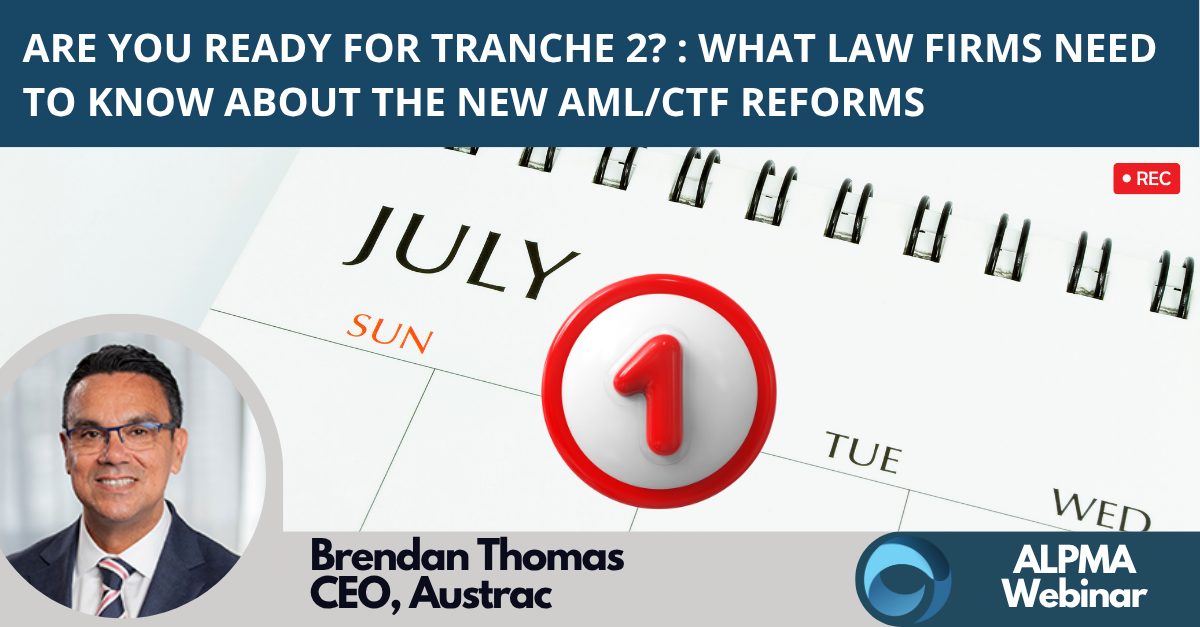
AUSTRAC has been clear that the transition period is over. In its 1 July announcement, CEO Brendan Thomas said “the laws are now in force – the expectation is compliance, and the alternative is enforcement.” That said, he has also said that AUSTRAC has never penalised a small business for administrative mistakes and there is still plenty of support available for those firms still finalising the details in their programs, even as compliance must begin.
29 July enrolment deadline
If your firm started providing a designated service on 1 July and hasn’t enrolled with AUSTRAC yet, the clock is running. Enrolment must be submitted within 28 days of first providing that service, which for most firms means a hard deadline of 29 July 2026.
New TTR/SMR forms now live
The threshold transaction report and suspicious matter report forms previewed in AUSTRAC Online last month are now the live forms for reporting. Transitional arrangements may still apply if your firm enrolled before 31 March, but for everyone else, these are the forms you’ll be using from here on out. Check that whoever handles reporting in your firm knows where to find them and how they differ from the old versions.
AUSTRAC contact centre
If your firm has questions specific to your circumstances, AUSTRAC has a dedicated contact centre for newly regulated entities, reachable at contact@austrac.gov.au or 1300 021 037 (Monday to Friday, 8:30am-7:00pm AEST).
Support Still Available
AML/CTF Q&A Member Connect | July 2026
July has arrived, but that doesn’t mean you’re on your own now. Join us for the July AML/CTF Q&A Member Connect – a free, informal space for ALPMA Members to bring whatever’s unresolved, ask the question you haven’t had time to chase down, and hear how others are navigating the same thing.
AML at the 2026 ALPMA Summit + ALTACON
AML compliance discussions will continue at the Summit on the ALTACON stage, with a practitioner-led Q&A on what is working, where firms are struggling, and what AUSTRAC engagement looks like in practice. A candid picture of early compliance experience and practical fixes for common implementation gaps.
Member Offer: 15% Off AML Resources from Holley Nethercote
Holley Nethercote is offering ALPMA members 15% off selected AML resources until 31 August, including a templated CDD Reliance Agreement for use between law firms, conveyancers, real estate and accounting firms, and their August webinar on outsourcing AML/CTF compliance.
Solicitors’ Conduct Rules Updates:
The Law Council of Australia has made amendments to the Australian Solicitors’ Conduct Rules (ASCR), published on 19 June 2026 and commencing 1 July 2026. These changes arrive at the same time Tranche 2 entities come under the AML/CTF regime, and they are directly connected.
Some Common AML Queries:
Receiving, holding, controlling or managing a person’s property: Who is your client?
A common question surrounds confusion on third-party money, for example a property buyer paying a deposit into your trust account on a matter where you act for a property developer. AUSTRAC’s Item 3 guidance is clear that your customer is the person you directly act for, not a counterparty whose money merely passes through your account. AUSTRAC has released guidance on their website here: Professional designated services | AUSTRAC
Charging clients for due diligence
Members have also been asking whether AML/CTF due diligence costs can be passed to clients. A useful document has been released by The Queensland Law Society on this topic.
The Queensland Law Society’s June 2026 position paper concludes that, in appropriate circumstances, yes you can. The distinction is between general AML program overhead (setting up your program, training, software, audits), which is absorbed in your rates and not chargeable without specific agreement, and customer due diligence done for a specific designated service matter, which is work specific to that client and matter and can be charged: third-party search fees as disbursements at cost, and reasonable solicitor or paralegal time at the rate appropriate to the task. Avoid charging for universal precautionary due diligence run on every client, which may not be necessary or chargeable, and do not present your own professional time as a disbursement. Disclose any charges in your costs agreement, and ideally obtain the client’s agreement. The paper can be viewed here.
CDD Reliance Agreement Template for related parties
Division 8 of the AML/CTF Rules 2025 allows you to rely on another party to collect and verify KYC information, but only if that party is a reporting entity, or a foreign person regulated under FATF equivalent laws, with measures in place to comply with the due diligence and record-keeping obligations; the reliance is appropriate to your risk; and you have reasonable grounds to believe you can obtain all the KYC information before you start the designated service. You must reassess the arrangement at least every two years and on any significant change. You can rely on a real estate agent or conveyancer who is a reporting entity, but you cannot offload onto a party outside the regime.
Holley Nethercote has made available to ALPMA members in their HN Hub (at a 15% discount) a templated CDD Reliance Agreement for use between law firm, conveyancer, real estate and accounting firms. Members can claim the 15% discount here.